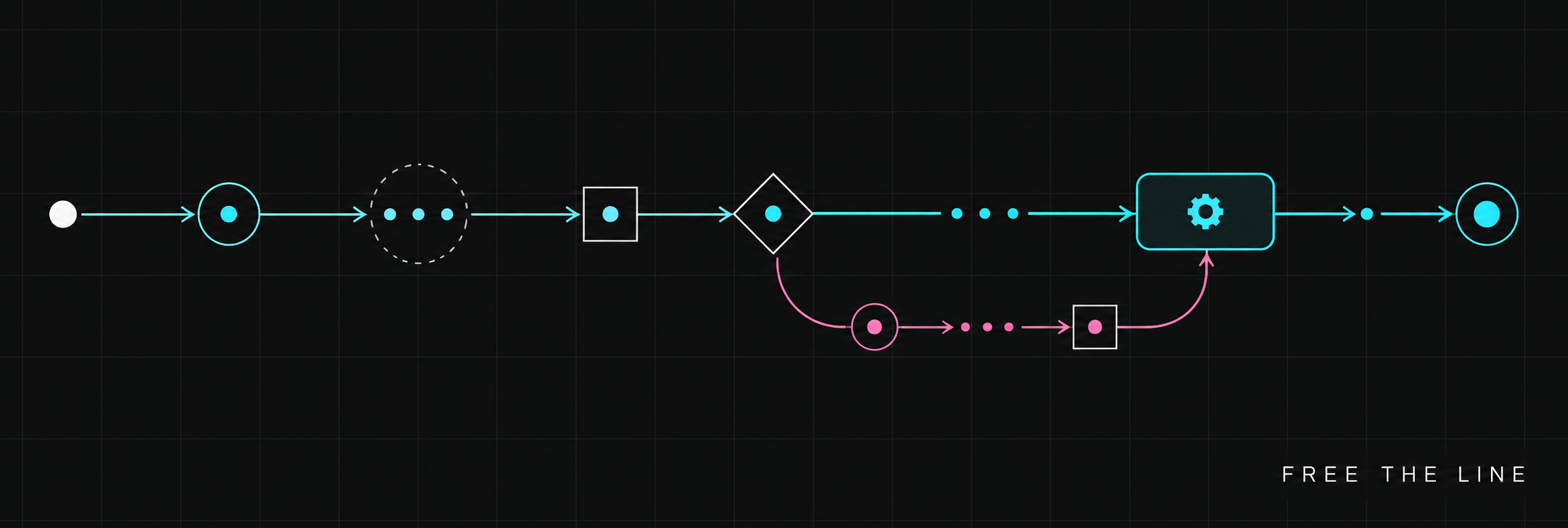
Automation has been touted as the answer to repetitive, slow, or frustrating tasks. A team determines there's a task that takes too long. Someone suggests using Artificial Intelligence, an integration, or a new software product. The organization then proceeds to build the solution before anyone fully understands what the process does, why it exists, or from where its data originates. That type of automation can help a disorganized process run faster but doesn't necessarily improve it. Before automating anything, however, Free the Line starts with an even more fundamental question: how does the work actually flow?
The Documented Process Isn't Always the True Process
Organizations generally document how work is performed. Someone submits a request. Someone reviews it. Data is entered. A manager approves it. The outcome is delivered or posted. Often, though, the actual process is far more complex. A request may come in via e-mail, text messages, a form, or verbally. There may be missing data. An employee may copy details into a spreadsheet before entering them into another application. Someone may approve based on an undocumented rule that they recall. Documents may reside in several locations. If a mistake occurs, someone may create an ad-hoc recovery process that only they understand. This doesn't imply that the employees performing the work are doing it badly. Informal processes frequently occur because employees are forced to compensate for deficiencies in the official process. These workarounds possess substantial knowledge. Automating the documented process while ignoring the unofficial process can result in the loss of human discretion which allowed the documented process to function.
Begin With Observation
Discovery is the first step in creating effective automation. This includes interviewing the individuals involved in performing the work; observing the process; assessing the tools and data utilized; and identifying what occurs when the established procedure fails. Questions to ask during the interview phase include: What initiates the process? Who participates? What information is required? Where does that information originate? Which source is considered definitive? What decisions must be made? Which decisions require expertise or discretion? What occurs when information is unavailable? At which points do people perform redundant work? At which points do delays or misunderstandings arise? What documentation must be maintained? Who is accountable for the outcome? What occurs when something goes awry? The responses will indicate whether the organization faces an automation challenge, a data challenge, a communication challenge, or a process that wasn't clearly defined initially.
Don't Just Map the Software — Map the People
As well, a flowchart depicting information flowing between applications can illustrate software interactions; however, software represents merely a portion of the overall system. People interpret incomplete requests. People recognize extraordinary circumstances. People maintain customer relationships. People decide when to question a rule. People remember why a prior decision was made.
Therefore, a responsible process map must include these contributions.
While this doesn't mean every human action must remain manual, it does imply that organizations must comprehend what each action achieves before eliminating it.
For instance, an employee appearing to manually copy information may also be verifying accuracy, correcting inconsistent formatting, eliminating duplicates, and identifying abnormalities. Automating this action with a direct integration could eliminate repetitive entries; however, it could also eliminate four unofficial quality controls. A better solution might automate the copying while formalizing validation rules.
Follow the Information
Typically, automation relies on data; however, organizations commonly start by integrating applications without evaluating the information contained therein. The same customer, product, project, article, asset, or transaction may exist in multiple systems. Each instance may contain differing attributes. No one may know which version is most current. Integrating these systems without establishing authoritative relationships can accelerate contradictions more effectively. Prior to developing an automated workflow, identify which record is authoritative; which fields can be automatically populated; which system owns each type of information; how conflict resolution occurs; how updates are distributed; what historical record must be preserved; which information is confidential; and where each element may be posted or distributed. These questions provide a basis for establishing dependable integration. Automation should move reliable information through an established process. Automation should not transform uncertainty into infrastructure.
Determine Decision Points
A process is not merely a sequence of tasks; it is also a sequence of decisions. Some decisions are repetitive and can be represented by rules. Other decisions depend upon context, risk, preference, ethics, or experience. A productive discovery process distinguishes between them. Software can verify that all required fields are populated. Software can recognize an exact duplicate; compute a value; assign a known category; generate a draft; or route work based upon predefined criteria.
However, a person may still need to decide whether an unusual source is reliable; whether a public statement reflects the organization's voice; whether an exception should be permitted; or whether a potentially destructive action should proceed. Artificial Intelligence can aid in preparing these decisions by summarizing evidence; identifying patterns; or suggesting a response. This does not automatically qualify AI as the appropriate final decision-maker. The appropriate automation boundary depends on the consequences of incorrectness.
Seek Friction That Is Significant to Operations
Not every inconvenience warrants a custom solution. A task performed for five minutes once per year may be easier to ignore. A slightly inconvenient user interface may not warrant a transition. Automating an unstable process can generate more maintenance than benefit. Free the Line seeks friction that represents significant operational challenges: work repeatedly generated from the same source; data copied among multiple platforms; delays in responding to requests due to lack of knowledge regarding their status; errors resulting from inconsistent records; knowledge available only to one individual; assets detached from their permissions or provenance; approval processes that cannot be reviewed subsequently; customers requested to submit identical information repeatedly; teams unable to locate the most recent version; and repetitive work consuming time needed for higher-value decision-making. The greatest automation opportunities are not necessarily those that are most obvious. Often, a minor improvement at the appropriate location eliminates friction from all subsequent processes.
Eliminate Complexity Before Automating
Automation should not perpetuate unnecessary complexity simply because the complexity already exists. Before initiating development, ask whether steps can be eliminated; information can be consolidated; responsibilities can be clarified; or requirements can be streamlined. A ten-step workflow may include three critical actions and seven historical workarounds. If the entire process is automated without analysis, the organization gains a faster ten-step workflow that remains incomprehensible. If the process is simplified first, the subsequent automation is easier to develop, test, maintain, and articulate. This is why thoughtful discovery generates superior technical results. Each superfluous rule eliminated prior to development is a rule that does not require becoming permanent code.
Plan for Failures and Exceptions
A successful demonstration typically displays the optimal route. Actual work entails missing information; duplicate records; lapsed credentials; unavailable services; incorrect files; conflicting directives; and unexpected user behaviors. A reliable system should make failure apparent; retain original information; allow for secure retries; prevent duplication; allow for corrections; notify relevant personnel; avoid hazardous incomplete results; and offer a manual alternative when automation is unable to proceed. A system that operates only when everything is flawless is a prototype, not an operational solution.
Measure the Correct Outcomes
Time saved is valuable; however, it is not the sole indicator of successful automation. A superior system may also decrease errors; clarify responsibilities; preserve organizational knowledge; enhance customer experience; create an auditable history; facilitate information retrieval; decrease reliance on individual memory; enable improved decisions; safeguard confidential information; and enable individuals to allocate more time toward creative or relational activities. The objective is not merely to increase speed in processes; it is to enable organizations to enhance their capacity.
Where AI Can Assist
AI can assist in analyzing existing documentation; comparing records; identifying patterns; summarizing interviews; proposing process maps; generating validation rules; categorizing inbound requests; producing content; and aiding in software development. AI's utility is increased when it receives accurate context and clearly defined boundaries. If the underlying process is misunderstood, AI will confidently operate within that misinterpretation. If the source data is unreliable, AI may produce polished output based upon inaccurate data.
Therefore, process discovery; authoritative data sources; provenance; governance; and human verification are central components of responsible AI integration.
The Free the Line Methodology
Free the Line combines systems analysis; web development; project management; creative production; and AI-assisted development. We do not commence by recommending a platform. We commence by comprehending the organization; the employees performing the work; the information they depend upon; the decisions they make; and the outcomes that the system must achieve. From this point forward, the most suitable solution may be a clearer process; an integration between existing applications; a custom web application; a governed information model; an AI-assisted workflow; or a larger interconnected system. Mission HQ evolved using this identical methodology. Its architectural design reflects years of authentic creative and operational work among artists; releases; assets; websites; publishing; merchandise; playlists; and other interconnected data. The platform was not designed based upon a catalog of trendy features. Rather, it was designed based upon work that required a better method for functioning. Discover Mission HQ to learn how Free the Line develops a governed framework for connected information and publishing.
Understand First. Automate Second.
Automation is most useful when it eliminates redundant repetition while retaining the knowledge; judgment; and accountability which enable work to be accomplished successfully. This requires more than integrating two applications or instructing AI to complete a task. It requires understanding how a process functions in reality. Follow the information. Observe the decisions made. Listen to the employees. Document exceptions. Remove unnecessary complexity before automating. Establish what is authoritative. Determine where human judgment belongs. Then automate what will truly improve the system. Read What Is Free the Line? or contact info@freetheline.com to discuss a workflow; integration; or systems project.